news header 750

R1TopIn addition to the all-new R1 that Valentino Rossi wheeled onto the stage during Yamaha’s 2015 model unveil at the EICMA show in Milan, Italy, the Japanese manufacturer also introduced its limited-edition 2015 R1M. Much like the limited-edition R1 models of yesteryear, the 2015 R1M gets the Öhlins treatment and a long list of other upgrades aimed at increased on-track performance. The fun hardly ends at the front fork, however, as in addition to the Electronic Racing Suspension (ERS) you also get carbon fibre bodywork, higher-spec Bridgestone tires, and a Communication Control Unit (CCU).


The R1M’s Suspension Control Unit (SCU) makes adjustments to the Öhlins suspension based on the data it’s continually gathering from the bike’s six-axis IMU and various sensors. The goal, as is the case with the electronic suspension on BMW’s new S 1000 RR, is to provide added stability under braking and increased traction on corner exits through changes to the rebound and compression damping. The ERS has Automatic and Manual modes, and within each of these two modes there is a selection of three different base settings, which enables you to fine-tune the bike for different tracks or conditions. In Manual mode, the system does not make adjustments to the settings, but rather sticks to your predetermined setup. Seat height is 5mm taller than on the stock model, a result of the new suspension.


The R1M gets carbon fibre bodywork and a polished aluminium tank. Interestingly, it weighs the same as the standard R1.


Yamaha claims that you can even adjust suspension with its Communication Control Unit, a user-friendly interface that allows you to communicate with the Yamaha Ride Control (YRC) through an Android app. The CCU also has a data logging function that enables you to record your data (lap times, speed, throttle position, GPS, lean angle, and more) and review it after your riding session, on a wireless tablet.

The R1M’s bodywork is made entirely of carbon fibre, while its fuel tank has a polished aluminium finish, not unlike the Panigale R Ducati debuted two years back. The paint is a metallic-looking silver with racing blue accents, whereas the wheels are blue and wrapped in special-compound Bridgestone tires in 200/55-ZR17 size at the rear and 120/70-ZR17 size at the front.


Applications for the limited-edition YZF-R1M can be submitted starting on December 1, 2014 and while there was no official word of exactly how many models will hit US shores, it was said that distributors will use their discretion when managing the allocation of R1M models. Yamaha has of course sweetened the pot by inviting each R1M owner to one of its Yamaha Racing Experience (YRE) events (of which there are four in July 2015, all across Europe). Here, R1M owners will have access to on-track training and technicians who can provide race set-up advice.


http://www.sportrider.com/sportbikes/2015-yamaha-yzf-r1-first-look?dom=sri&loc=rightrail&lnk=IMG

http://www.yamaha.co.za/


end bike test


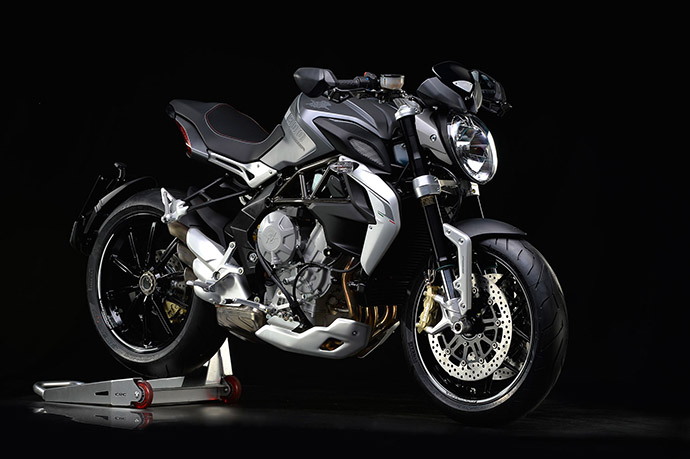
MV Brutale Dragster

German vehicles group Daimler is in advanced talks to take a minority stake in Italian motorcycle manufacturer MV Agusta, a source in Italy familiar with the situation said on Tuesday. The source said no deal had been finalised but it could involve Daimler buying a stake of 20 to 25 percent and helping the company expand outside Italy, where it makes one fifth of its sales, through an investment plan.

The source said MV Agusta was not looking for a financial investor but an industrial partner that can help it expand overseas. Daimler and MV Agusta declined to comment.

“This was mentioned in our talks with the Italian factory, said Craig Langton DP for MV Agusta SA and the Cayenne Group. MV Agusta is a very successful brand and grows its sales year after year; however the buy in from Daimler can only improve their current status and give them the edge over their competitor’s world wide”

German daily Sueddeutsche Zeitung said earlier on Tuesday that Daimler would buy a 25 percent stake via its AMG performance cars unit for around 30 million euros ($39 million), with an option to raise its holding in exchange for further investments, citing financial sources in Milan. A deal could be signed as early as next week, it added.

Buying a stake in Agusta would give Daimler access to a range of high-performance three-cylinder engines which the Italian company has developed for its superbikes.

Interest in these lighter gasoline-fuelled engines has increased as tougher anti-pollution rules force automakers to use lightweight technology, including for compact engines used in hybrid vehicles.

Earlier this month Daimler said it would introduce 10 new hybrid vehicles by 2017. Volkswagen's sports car unit Audi bought rival motorbike maker Ducati from Italian private equity investor Investindustrial in 2012, when Daimler denied media reports that it was also interested in buying Ducati.

Family-owned Agusta said last year it was seeking funding for an ambitious expansion plan which included the possibility of listing on the stock market. The Castiglioni family which owns Agusta hired Giorgio Girelli, a former chief executive of Banca Generali to help push expansion plans and a possible listing. Recent stock-market volatility has however made listing on the stock exchange more difficult.

A legendary name in motorcycling, MV Agusta won no fewer than 75 world championship rider and constructor titles before largely disappearing in the 1970 and making a comeback in 2014

Its rebirth in 1992 under motorcycle entrepreneur Claudio Castiglioni and renowned designer Massimo Tamburini created the F4 superbike, one of which belonged to King Juan Carlos of Spain and was loaned out to the Guggenheim Museum for an exhibit.

In the past 10 years, however, the brand has repeatedly come under financial duress and gone through several owners that included Harley-Davidson and Malaysian state-owned carmaker Proton. It was bought back in 2010 by Castiglioni shortly before he died, and is now run by his son.

Both MV Agusta and Ducati also compete with Italy's other major sports bike maker Aprilia, a unit of Piaggio. 

end bike test


APRILIA RSV125 TOGETHER 00KMSA Distributors is to discontinue the importation and distribution of Aprilia and Moto Guzzi motorcycles and parts in South Africa.

The Italian brands have been part of KMSA’s product line since 2007 and 2012 respectively, while the company has been the sole importer of Kawasaki products in Southern Africa for 37 years, and took on the burgeoning Triumph motorcycle and accessory brand two decades ago.

“Earlier this year we also acquired the Sym scooter distribution rights and within six months, sales exceeded the best results of the previous importers over the twenty years Sym has been in the country,” says KMSA’s MD, Chris Speight. “With Kawasaki, Triumph and Sym all being well-established mainstream brands we felt that the Italian machines that appeal to a small niche market were tying up too large a portion of our resources.

On 5th June this year we informed Piaggio & C. SpA, who own both Aprilia and Moto Guzzi, of our decision to relinquish the brands, but undertook that we would continue honouring and managing warranties and providing parts for the bikes in South Africa until such time a successor has been appointed. In line with KMSA’s ethical business practices it was deemed that this would be the correct way forward without compromising Aprilia and Moto Guzzi’s brand integrity or customer confidence and expectations. No new South African distributor has as yet been appointed. end bike test


Goodwood 1

by Ian Groat 

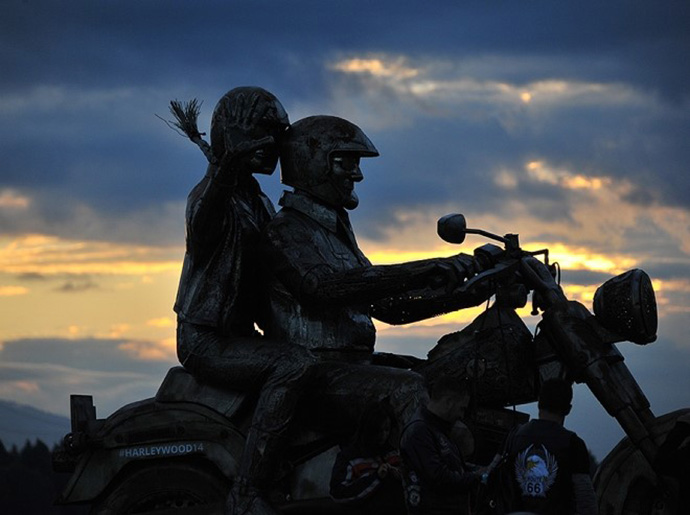
Tucked away in the race programme at Goodwood is the two part Barry Sheene Memorial race. It is set over sixteen laps per day and features two riders per team to contest the trophy and it has a Le Mans type start and last year South Africa was represented by Team Incomplete’ with Jimmie Guthrie and Peter Labuschagne who posted a mid-finish to the race. This years race however morphs into machines produced way back in the early fifties and with 31 teams set to do battle on long stroke Manx Nortons and early Triumph Twins as well as only one four cylinder Gilera came out to play.barry Sheene2

This year it was the turn of Australian aces Beau Beaton and Craig McMartin who brought a super swift 1948 Vincent Rapide from KH?Equipment to put the cat among pigeons in the normal Manx Norton pecking order winning list.  There were also noteable world champions in the entry list in the form of Kevin Schwantz, Micheal Rutter, Troy Corser and Steve Plator.

Practice and race days were held in unusually balmy autumn weather conditions and the Vincent took pole for the first leg after a frantic start which saw Irish super star Jeremy Williams suffer a fall on the track to damage the 1952 Manx front forks irrepairably.  After the rider change the mighty Vincent which had an extra 50 horse power advantage over the competition disappeared into the blue yonder. With both riders overcoming the bikes refusal to brake well around any corner, Steve Plator, former TT winner and commentator rode a solid stint with Glen English to take second after a huge scrap with Scott Smart for the podium places. The motorcycle news tester, Adam Child scooped fourth on a Matchless C80 from 1954.barry Sheene5

With the Vincent’s obvious superiority and despite its huge size and weight, the organisers let a later 1961 Manx into the second leg, ridden by Jeremy McWilliams and Duncan Fitchet. This machine was to produce the race scap of the weekend. Troy Corser struck trouble with the Sebastian Gutsch 1937 BMW R5 SS and was out of the first race. Also side lined was the Gilera of Brian Richards as all types of mechanical mayhem struck these old clunkers from 70 years agoBary Sheene3

In the second leg the Vincent 1000 didn’t have it all its own way for the nimbler 1961 Barbour Norton Manx harassed and out rode the bigger machine time and time again to bring the crowds to their feet and despite winning by a wheel as they crossed the line for the checquered flag and ominous puff of blue smoke saw the Rapide blow up its gear box. However, despite that they took the overall win for the two part trophy race. Second was the Fred Walmsley Manx Norton from 1953 with Plator and English on board. While Child and Ling road a brilliant race to scoop the final podium position in another race where some  favorites fell by the way with mechanical failure in the least of  the moment.

The Schwantz/o’ Connor Manx Norton brought all the way from New Zealand by ace Turner MacIntosh took a well deserved fourth in the memorial final placings in a race that featured bikes that started their lives some 75 years ago and are still very fast, even by modern standards.Barry Sheene1 end bike test


The new 2015 Kawasaki Versys 1000 ABS, is now powered by a 1,043cc inline-four with a claimed 120 horsepower. A balance shaft partly cancels the natural tendency of an inline-four to vibrate because of secondary imbalance.  

In Kawasaki tradition, great attention was paid to optimizing engine performance. The Versys 1000 four-cylinder is fed through four 38mm throttle bodies, for smoother throttle response, and the precisely tuned exhaust system has cylinders 1-4 and 2-3 interconnected. An ample electronics suite includes ABS, traction control, and two levels of power delivery.

The 2015 Versys 1000 ABS is a fairly tall bike, riding on suspension that features an inverted 43mm fork and a new link-type rear that brings the seat height up to 33.1 in. A new twin-spar aluminum frame is employed, and wheelbase is 59.8 inches. The steering geometry appears to be set for maximum stability, even on uneven surfaces, thanks to 27 degrees of rake and 4.2 in. of trail. Also new is the fairing, a more protective part that features an adjustable windshield. Bags and top case are said to be more easily installed and removed.

Equally renewed is the 2015 Kawasaki Versys 650 ABS, a junior version powered by the very pleasant 650cc parallel-twin. For 2015, the engine has gained a little power. It now has a claimed 69 horsepower, and it has been tuned for enhanced torque delivery and tractability.

The Kawasaki Versys 650 ABS has undergone what I would call a general upgrade, and it has been made more comfortable with a larger fairing and windscreen, revised rubber mounts for the engine, handlebar and pegs, plus the inverted 41mm long-travel fork and a new remotely adjustable shock absorber. ABS is also available.

end bike test


ducati-scrambler-027-1


Meet the new Ducati Scrambler Classic. It features a stylish design inspired by the classic models of the ‘70s, but is fitted with all it needs to make you feel like you are ridging a contemporary motorcycle.

We especially like the aluminium front and rear mudguards, the spoke wheels, the 13.5 liters tear drop steel fuel tank with a capacity of 13.5 l and the brown seat with diamond-shaped inserts.

The stopping power is assured by semi-floating mono discs with 4-piston, radially mounted Monobloc Brembo calipers and ABS.

Other features that are worthy of being mentioned include a single Kayaba shock absorber with preload regulation, a passenger grab rail, Aluminum front/rear mudguards and an LCD dashboard with interchangeable aluminum cover.

http://scramblerducati.com/en/

end bike test


SX1190  White R

The Cayenne Group will land their second EBR model next month the model that has taken the world market by storm, excited all the media with the international road tests and the model everyone has been waiting for the EBR 1190 SX Superfighter arrives next month

“This is the model that we have been waiting for it has had some really outstanding raves worldwide and looks fast just standing still.” said Craig Langton dealer principal of the Cayenne Group. “It gives us another model option in the EBR range and judging by its sales success and the media’s comments internationally it will be a winner.”

The legendary Eric Buell who titled the new EBR 1190 SX as the Superfighter said the SX is the ultimate sports motorcycle”

Following the successful introduction of their 1190 RS and then the RX superbike, Erik Buell Racing introduced the EBR 1190 SX, a true naked street fighter-styled sport bike with uncompromised Superbike race-bred performance and handling.1190RS Rear Black

Sharing the 1190 RX's V-Twin engine rated at 185 crankshaft horsepower and more than 136 Nm of torque, the new EBR 1190 SX delivers the highest performance available in the street fighter category. EBR founder and Chief Technical Officer Erik Buell is no stranger to street fighter-style sport bikes, having defined the category with the introduction of the S1 Lightning in 1995.

 "The street fighter classification, which was so revolutionary when we first came to market, is now being used by marketing people for all sorts of motorcycles, including some thinly-disguised standard bikes that have de-tuned or obsolete powertrains," said Buell. "So, perhaps the appropriate new name for a bike like the 1190 SX is, 'Superfighter'."

With much componentry carried over from the EBR 1190 RX superbike, the 1190 SX is a genuine high-performance motorcycle with a racing heritage. True to its 'street fighter' designation, however, the 1190 SX is designed to be a dominating street machine. Featuring an athletic upright riding position and wider handlebars for nimble handling, and minimalist bodywork for lower weight, the 1190 SX is equally at home carving mountain passes on the open road or taking on the concrete jungle of the city. As with all EBR sport bikes, the 1190 SX features many Erik Buell signature innovations to optimize handling and performance, such as fuel in the frame for lower weight and centralized mass, hubless wheels and huge perimeter brake rotors for lower unsprung weight, and EBR's proprietary Controlled Swirl Induction (CSI), which improves power and fuel economy, while lowering exhaust emissions.

"This new naked sportbike EBR entered an important market segment in Europe," said Edwin Belonje, Managing Director EBR Europe. "The 1190 SX has boosted sales of EBR’s in Europe and has strengthened our market presence."1190SX Red Right

“Like all our exotic brands and following our current EBR the policy, customers will get a Service for Life plan with the EBR and will also be illegible for our exclusive MFC financial package consisting of the normal warranty, a guaranteed 5 year buy back, no deposit, free licence and registration, the first ever residual in the industry, also if required is our new Cayenne Accessory finance package.” said Craig Langton. 

For more information call Cayenne 011 244 1900 or visit their web site www.cayenne.co.zaend bike test


15 ZX1000P Styling01

When Kawasaki first conceived the Ninja H2R, the driving development concept was to offer the kind of acceleration no rider had experienced before.
That a motorcycle be "Fun to Ride" is one of Kawasaki's guiding principles. But while there are many ways for a motorcycle to be enjoyed, it was felt that having incredible acceleration was a major factor in delivering ultimate riding exhilaration.

Powering the Ninja H2R is a supercharged engine with a design target of 300 PS allied to a compact design on par with power units found in supersport litre-class models. The key to achieving this incredible performance lies in the engine's supercharger—a motorcycle-specific unit designed completely in-house with technology from other companies within the Kawasaki Heavy Industries (KHI) Group: the Gas Turbine & Machinery Company, Aerospace Company and Corporate Technology Division.

KHI Group technology was not limited to the supercharger. Advanced technological know-how shared from other group companies is found throughout the all-new engine and chassis design. For example, the carbon-fibre upper and lower wings that ensure stability when riding in the ultra-high speed range were designed with assistance from Kawasaki's Aerospace Company. This is but one example, and this inter-group collaboration combined with the level of technology poured into this model is the reason the Kawasaki River Mark* is displayed prominently on the front of the Ninja H2R.

When it came time to name this model, using "Ninja"—a name synonymous with Kawasaki performance and shared by many legendary models over three historic decades—was an obvious choice. But this model is also named for another epoch-making model, whose 2-stroke 748 cm3 Triple gave it an intense acceleration that made it a sensation around the world: the Mach IV 750, also known as the "H2." For a model designed to offer "the kind of acceleration no rider has experienced before"we can think of no better name.

Built Beyond Belief. In 2014, Kawasaki is once again ready to unleash a new sensation upon the world.

*The Kawasaki River Mark is a long-time symbol of the KHI Group dating back to the 1870s. As a policy, its use on products is rare and limited to models with historical significance. But for the Ninja H2R permission to use this symbol was granted. 15 ZX1000P Styling02

KEY FEATURES

Never-before-experienced Acceleration

In order to be able to offer intense acceleration and a top speed in a range that most riders never have a chance to experience, it was essential that the engine be able to produce big power. While a large-displacement engine could easily provide a high engine output, to ensure a lightweight, compact overall package a compact engine was also desired. Using a supercharged engine allowed both of these engine design requirements to be met: maximum power output has been targeted at 300 PS, and the engine size of the 998 cm3 In-Line Four is on par with other supersport litre-class power units.

In-house-designed Supercharger

The supercharger used in the Ninja H2R was designed by Kawasaki motorcycle engine designers with assistance from other companies within the KHI Group, namely the Gas Turbine & Machinery Company, Aerospace Company, and the Corporate Technology Division. Designing the supercharger in-house allowed it to be developed to perfectly match the engine characteristics of the Ninja H2R. The highly efficient, motorcycle-specific supercharger was the key to achieving the maximum power and the intense acceleration that engineers wanted to offer.

15 ZX1000P Styling03

Chassis Design

The objectives for the Ninja H2R's chassis were to ensure supreme stability at ultra-high speeds, offer cornering performance to be able to enjoy riding on a closed course, and finally to have a highly accommodating character. Ordinarily, high-speed stability can easily be achieved with a long wheelbase, but a shorter wheelbase was selected to achieve the compact overall package and sharp handling that were also desired. The frame needed not only to be stiff, but also to be able to absorb external disturbances, which, when encountered while riding in the ultra-high speed range, could easily unsettle a lesser chassis. A new trellis frame developed using the latest analysis technology provided both the strength to harness the incredible power of the supercharged engine, and the balanced flex to achieve the stability and feedback for high-speed riding.

Aerodynamics

As speed increases, wind resistance increases exponentially. To be able to operate in the ultra-high speed range, a combination of high power and slippery aerodynamics was needed. With power requirements taken care of by the supercharged engine, the next step was to design bodywork that both minimised drag and added control when riding at ultra-high speed. Assistance from Kawasaki's Aerospace Company was enlisted in creating the aerodynamically sculpted bodywork to ensure maximum aerodynamic efficiency.

15 ZX1000P Styling05

Intense-Force Design & Craftsmanship

Wanting to ensure a bold design worthy of a model that carried both the "Ninja"and "H2"names, the prime styling concept chosen for the Ninja H2R was "Intense Force Design." As a flagship for the Kawasaki brand, it required presence, and a styling that reflected its incredible performance. But the design is much more than cosmetic. While it certainly looks the part, the Ninja H2R also possesses a functional beauty: each piece of its bodywork was aerodynamically sculpted to enhance stability at ultra-high speeds; the cowling design also maximises cooling performance and heat dissipation, aiding in achieving the engine's roughly 300 PS output; and the Ram Air duct is ideally positioned to bring fresh air to the supercharger. More than any motorcycle Kawasaki has built to date, the Ninja H2R is a showcase of craftsmanship, build quality and superb fit and finish—right down to the high-tech mirrored-finish black chrome paint specially developed for this model.

SPECIFICATIONS - Ninja H2R

Engine Type: Supercharged liquid-cooled In-Line Four
Displacement: 998 cm3
Supercharger Type: Centrifugal-type
Maximum Power: Design target 300 PS
Frame Type: Trellis, high-tensile steel
Tyre, Front: 120/600R17 (racing slick tyre)
Tyre, Rear: 190/650R17 (racing slick tyre)

NOTES

1. The Ninja H2R is a closed-course model; it may not be ridden on public roads.
2. The street model (Ninja H2) will be released at EICMA on November 4.
end bike test


Now this could really put the screws to the Middle East and the carbon foot print...

All I can say is, “WOW!” 
What is this? 
Will it be the next big thing?
Tata Motors of India thinks so.
What will the Oil Companies do to stop it?

It's an auto engine that runs on air. That's right; air not gas or diesel or electric but just the air around us. 
Take a look.

tata air

Tata Motors of India has scheduled the Air Car to hit Indian streets

The Air Car, developed by ex-Formula One engineer Guy N. For Luxembourg-based MDI, uses compressed air to push its engine's pistons and make the car go.

The Air Car, called the "Mini CAT" could cost around 365,757 rupees in India or $8,177 US.

The Mini CAT which is a simple, light urban car, with a tubular chassis, a body of fiberglass that is glued not welded and powered by compressed air.  A Microprocessor is used to control all electrical functions of the car.  One tiny radio transmitter sends instructions to the lights, turn signals and every other electrical device on the car.  Which are not many.

The temperature of the clean air expelled by the exhaust pipe is between 0-15 degrees below zero, which makes it suitable for use by the internal air conditioning system with no need for gases or loss of power.

There are no keys, just an access card which can be read by the car from your pocket.  According to the designers, it costs less than 50 rupees per 100 KM, that's about a tenth the cost of a car running on gas. Its mileage is about double that of the most advanced electric car, a factor which makes it a perfect choice for city motorists.  The car has a top speed of 105 KM per hour or 60 mph and would have a range of around 300 km or 185 miles between refuels.  Refilling the car will take place at adapted gas stations with special air compressors.  A fill up will only take two to three minutes and costs approximately 100 rupees ($1.78 CAD!) and the car will be ready to go another 300 kilometers.

This car can also be filled at home with it's on board compressor.  It will take 3-4 hours to refill the tank, but it can be done while you sleep. 

Because there is no combustion engine, changing the 1 liter of vegetable oil is only necessary every 50,000 KM or 30,000 miles. 
Due to its simplicity, there is very little maintenance to be done on this car.

This Air Car almost sounds too good to be true.    

P.S.  If Mr Tata and Mr Guy succumb to a mysterious illness or dies in an accident, then you know how the oil companies have reacted, as they have done in the past when faced with the prospect of sudden diminished demand for their oil.

end bike test


favicon4