




words by: Clinton Pienaar
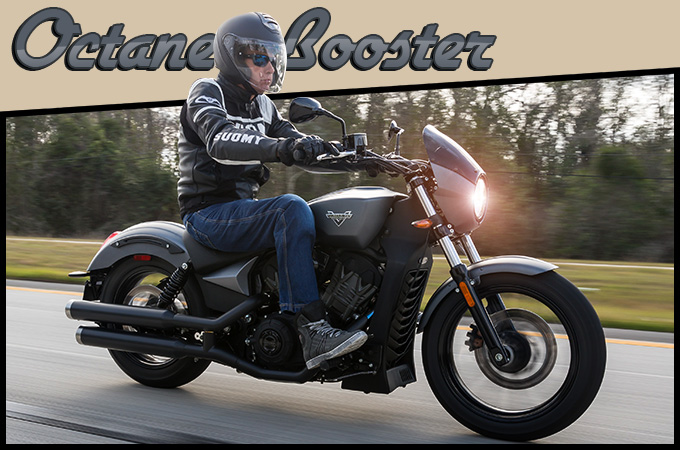
We are all familiar with the muscle car formula, take a big motor, put it into a lightweight chassis and strip out all the unnecessary items. Victory has done the same in the biking world and, what you end up with is an authentic, pure American Muscle Bike.
I was flown out to Daytona for the world launch of the new Victory Octane model. A few months back we featured the Indian Scout and if you look at the images of the Scout against the Victory Octane, don’t you think the Octane simply looks like badge engineering? As we headed out of town for a two-hour ride, without any pre-ride technical briefing beforehand, we travelled through some very picturesque back roads en route to Orlando Speed World. First impressions were good, the bike’s motor felt crisp and rev-vie, and my initial thoughts were to give sea level the credit but I was wrong as I later found out. Going back to the badge engineering statement I made earlier, this bike uses more than 65% different parts and is definitely not an Indian Scout, although there are some parts which they do share. So why were we taking cruisers to a drag strip, what’s up with that? Anyway, the ride up was relaxing and the back road countryside curves were enjoyable. I was impressed with the ground clearance in cruiser world terms. This way of riding makes perfect sense, it’s an expression of freedom and one that I realise I have been fighting for my entire life but let’s go back to the beginning.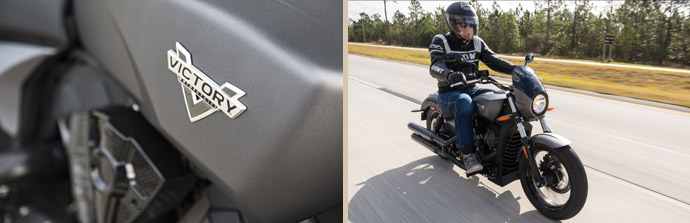
The arrival of this bike and its potential performance has also been hinted at by famous builders like Roland Sand’s Project 156 ridden at Pikes Peak, Urs Erbacher’s Ignition bike and Zach Ness’s Combustion bike. It’s also a bit of a direction change for parent company Polaris who has been making huge strides in Northern America, arguably their most important market. An interesting fact is that Polaris actually outsells Honda and Yamaha in the very popular off-road four wheeler market not to mention the good job they are doing with Indian Motorcycles.
‘We wanted to bring the American motorcycle into the 21st century,’ Victory Senior Industrial Designer Mike Song says. ‘Victory doesn’t have any long history or legacy—we are a new brand and we can go wherever we want to go. We want to be modern, and bold, and set our own trends.’
Octane was visually inspired by one of Song’s earlier concept bikes, named ‘Core.’ That bike was a modern interpretation of an old concept—the American V-twin bobber—brought into a new century. Modern form language and the latest technology were applied to something that’s been in our culture for a long time, to create a new type of motorcycle.
‘Octane is for anyone who likes excitement,’ Song says. ‘It handles well, offers a lot of performance, and contemporary styling to go with it. It’s meant for someone young, who wants something fresh, new and modern.’
Moving into the middleweight category is a big step toward expanding the Victory product line. ‘The basic Octane platform is so versatile,’ Song says, ‘allowing us to do things we’ve never done before. We can take this design in several directions, opening the door for Victory to venture into segments outside of traditional cruisers, drawing in younger riders and new buyers.’
In other words, Octane is just the first step in an entirely new direction for American motorcycle development.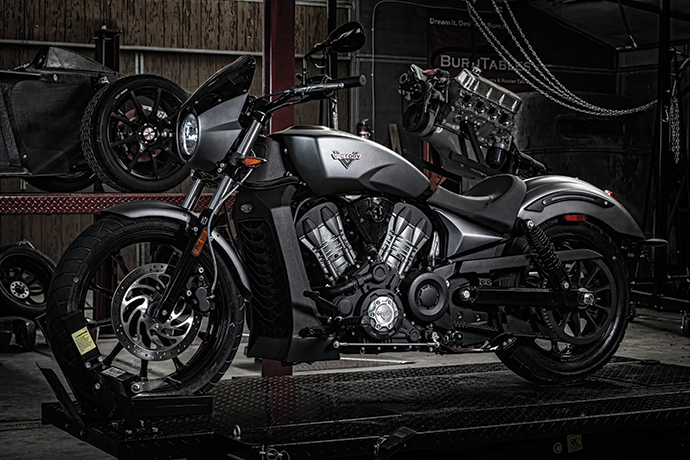
But let me delve into the details for you, for the first time Victory is producing a liquid cooled V-twin 1,179cc with 4 valves per cylinder with dual overhead cams that can rev easily past 8,000rpm producing 104hp. This might not sound that high or that much but it’s the way in which it makes the power and the way it revs. It also produces the most horsepower a Victory motorcycle has ever made which makes it the fastest ever Victory over a 1/4 mile and from 0 to 100 km/h. So this explains why we ended up at the Orlando Speedworld Dragway. There were about 30 journalists from around the world and we were divided into three groups; mainly rolling burnouts, gymkhana and 1/4 mile drags. Strange for a cruiser launch I thought, but my scepticism was quickly put aside. Victory had their two hotshot show riders there who performed high speed drifts around the track, vertical wheelies and rolling burnouts and to say I was impressed is an understatement. This is obviously a cruiser with a difference. Just to be clear on the differences between the Octane and the Scout, the insides of the engine might be similar but capacity is up from 1,133cc to 1,179cc because of a 2mm bigger bore. Cams are also different as well as cylinder and cylinder heads. I managed to do my 1/4 mile in just over 12 seconds again giving testament to the performance. The engine has a lovely character and in this day and age it’s nice to see what engineers can come up with when they don’t only have to chase outright performance but rather concentrate on rideability and smoothness. Once in top gear you could let it get as low as just above idle and without gearing down the bike builds up comfortably and with enthusiasm.  Moving onto the chassis, it’s long and the wheelbase is at 1,564mm and the bike has a low seat height. The front wheel is a wide 130/70 x 18 while the rear is a 160/70 x 17. The rake is at 29 degrees again depicting a sporty slant on cruiser geometry. The frame structure design is similar to that of the Scout with large front and rear aluminium castings bolting directly to the engine and two smaller aluminium frame rails tieing these together under the tank. The big radiator is caged in the two big casting beams and I very much like the look. I know, I know, how can you have liquid cooling on a cruiser but hey, the rest of the world has been doing it for ages and time waits for no man.
Drive is through a belt and is 8% shorter than the Scout. We only had a brief encounter with highways on this bike but for SA I think guys might opt for the slightly taller gearing. The seating position is feet forward and with such a low seat and pulled back bars, for the type of riding we were doing this made sense to me. Even the little wind cowl/fairing kept me happy and I was wearing an open face helmet. Size-wise at over 6 foot I was not cramped but the bike did feel small to me. If you are a little vertically challenged they have options in the form of bringing the foot position closer to you, the seat gets some more sponge to get you a little further forward and the bars come a little closer. All small adjustments but when I sat on the bike with the three done, it was amazing how compact the bike felt.
Instrumentation is also kept to a bare minimum with just a speedo present. There is an optional rev counter available, but again why would you add this? This is minimalism at its best, so don’t change it.
Brakes are the same size front and back at 298mm and they have braided hoses. I loved the back brake but I thought the front could have offered a little more bite. The bikes we rode were not fitted with ABS but the ones coming to South Africa will have it as standard.
Lastly, someone at the EU emissions control needs to be shot. The bike’s standard pipe is much too quiet which can’t possibly make anybody happy. There is an aftermarket pipe available and this modification transforms the bike and makes it sound the way I’m sure the engineers planned them to sound.
In summary, this is a muscle bike with a difference, not just a cruiser. Who is going to buy it you may ask? It’s got enough power to satisfy the big bruisers out there but it’s not a barge and with its low seat even the ladies are going to love it. I for one think that this bike is going to appeal to younger, hip riders as well because of the darker colours and stealthy look. 


