




Words by Clinton Piechart:
I'm actually lost for words, for the first time in my life my wife would add. Two issues ago I came back from testing all the leading RRs in the different championships around the world and my conclusion then was that they were all fantastic but the one that stood out head and shoulders above the rest was Barrier’s World Superbike. Not from a power point of view but rather from its user friendliness and the perceived control I seemed to feel I had over the bike. I've now ridden the latest incarnation from BMW, the fourth version of the bike they launched in 2009 (if you count the HP4) and I've come away speechless because BMW has actually tried to copy his (Barrier’s) bike. Even though the bike is 4hp stronger and 4kg lighter than its predecessor it has not become more of a knife's edge to ride, but rather it’s become easier and more controllable to ride. The grey area between where the electronics start helping you and where you think you are a fantastic rider get blurred quite quickly and you’re not sure where the one has let off and the other is taking over, it’s so seamless, so surreal.
 Let me start off with where the test was being held and, again, Spain was the chosen country but this time the fairly tight Monteblanco Circuit was going to be our destination. I say tight because, even though it is almost 4km long, it has a few hairpin bends after really fast straights, especially the start/finish one, and it did give us a chance to sample the HP Gear Assist Pro feature in extreme braking situations as well as the new added levels of traction control. Let me add to this that whoever has not got this one piece of new technology on their bike next year, will lose to the competition who does, period! It is ground-breaking, record shattering new technology and I predict that within a year or two all hypersport bikes will have it in their armoury. Let me give you an example of where it works: We are all competitive, we just can't help it and, even at launches, we try to go faster than the next guy, at the very least trying to match the BMW test rider who always seems to have the edge. I wanted to try and use the different systems to be able to report on them accurately so, every time I tucked in behind the bubble, almost red-lining the bike in 5th, and tried to push my braking marker just that little bit further. Don't ask me how fast I was going or what my lean angle sensor was saying, because at each moment I was focussed on the 200m board trying to get a smidgeon past it before I slammed the throttle shut and started pulling on the front brake lever. Shit, I'd left it a little late because I was barrelling towards a first gear hairpin bend! I had a white knuckle grip on the bars and the front brake and the last thing I wanted to do then was blip the throttle and pull in the clutch, there was no time! I banged down the 4 gears in fairly rapid succession and all of sudden my panic turned into a bit of calm as the acknowledgement of what this technology does came over me. I had just braked later than what I ever would have dared and got away with it because technology helped me. While I was panicking thinking of my Spanish real estate in the kitty litter, a little tin man (bike's computer) was stiffening up my front suspension at a rate of 100 times a second, every ten milliseconds! His mate was making sure that my front wheel did not lock or that the back wheel came up off the ground and that the back end did not get out of shape. So too was the suspension being checked at the rear, and that the slipper clutch was working and, with each clutchless down-shift, the bike blipped the throttle all on its own; no clutch action required, just seamless down- shifts which helped me slow down even more with a bike that was 100% stable and not diving too much in the front. So the lap after that one, at just past the 200m board, I braked and this time with a little less panic as I was now starting to trust in my little German tin man's ability.
Technology is fantastic and it begs the question of where it will end or at what stage, more precisely, it will slow down? Ok, so I had made the corner and I was hoping to catch the rider in front of me but he was really going, leaving thin black lines as he exited. The black lines left by him were so controlled that I caught myself actually staring at them more than what I should have. I had the bike cranked over as low as I dared to go (oh yes, you can tell later on download exactly how wimpish you were to the last degree, but more about that just now) and I started winding the throttle on, harder than you'd dare on a non-traction controlled bike. The torque is obviously in a broader band than the model before and this bike is so useable I’d think to myself but I'd like a little less holding back from the traction control on the exit of the turn.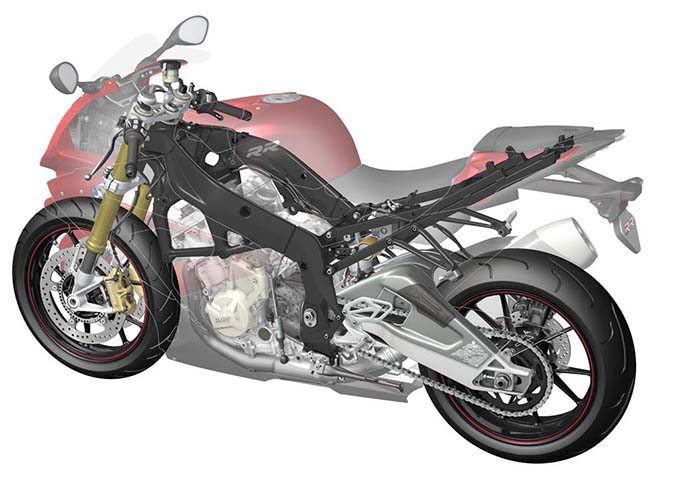
On the next straight I flicked a switch down and I got 1 out of 15 settings more spin on the back wheel. I was now at minus three out of a total of minus 7 up to 0 and then right up to plus 7 which is for completely wet roads on urban streets. I was exiting corners faster and with more confidence than what I've ever done in my whole racing career. The back wheel was sliding ever so slightly just to give me, for my riding limit/level, my utmost forward propulsion. Would I have liked to go to minus 4? Maybe not then and definitely not on a world launch where I wanted to give them their bike back in one piece. All the time while this was taking place the suspension was sorting out bumps and giving me the maximum traction from the rear so I needed to start altering my riding style to put a few more horses down, because it was not up to me anymore. I had the throttle pinned, my tin man was calculating how much power he could give me at my current lean angle, wheel speed, road speed, road traction and yaw of the bike. It is simply unbelievable and never have I ridden a bike that made me want to go back and race again. This bike takes your own personal levels and just pushes them up. The thought did come to me that when things do eventually go wrong, and they all eventually do when you are pushing harder and harder, the crash is going to be spectacular! Maybe this new airbag race suit is not a bad idea!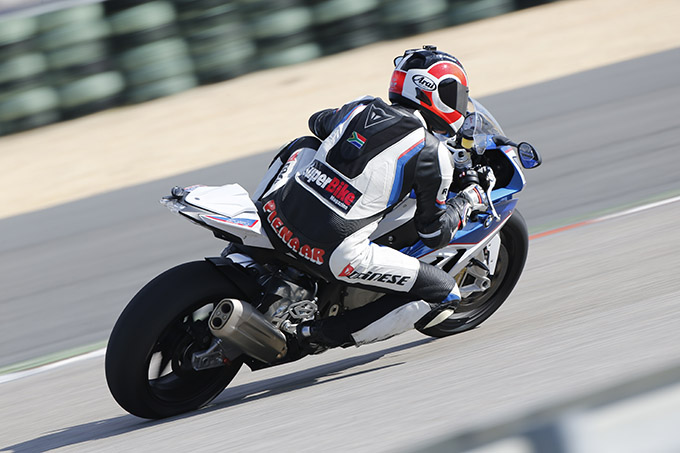
This bike is a full 10% better than the bike it replaces in every aspect and I'm going to try and take you through what makes it so special now.
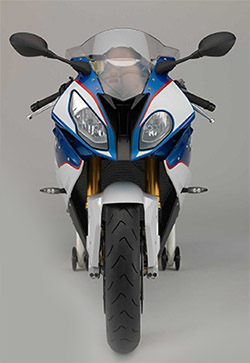
At first glance the bike looks obviously like the replacement of the current model. It has a purposeful lip on the bottom of the front fairing but it is instantly recognisable. The controversial front headlights are also modernised and, all in all, the bike looks a little more refined and fresh.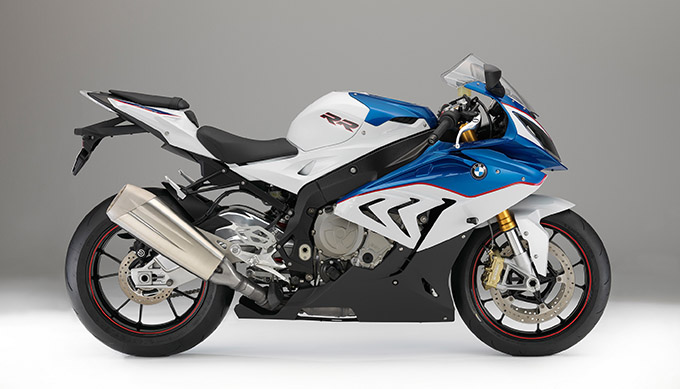
Performance figure is 4hp up to a claimed 199hp and weight is 4kg down which brings the bike to 204kg fully fuelled. In their press conference BMW said that all of their bikes will make a minimum of 199hp and it truly felt like it. The biggest gain from the motor, however, is not the ultimate 4hp gain but rather the spread of the torque which is over a broader range and ultimately makes for easier control. The enhanced performance of the new RR in terms of drive power can be attributed to the re-engineered cylinder head with new duct geometry, new intake camshaft and even lighter intake valves. Furthermore, an air box with a modified capacity combines with an intake system with shorter intake lengths to make mixture preparation more effective than ever and give the new S 1000 RR added punch.
Chassis-wise, the new RR has been honed with the introduction of a new, lighter frame structure offering an optimised blend of rigidity and flexibility. Together with the optimised chassis geometry featuring redefined values for the steering head angle, wheel castor, wheelbase and swingarm pivot point, it gives even better handling, increased traction and good feedback, particularly when riding at the limit. The tasks of wheel suspension and damping continue to be performed by fully adjustable spring elements, but with modified negative spring travel for more banking clearance and greater agility. As a factory-fitted option, the new S 1000 RR can also be specified with the new improved version of the electronically controlled Dynamic Damping Control (DDC) suspension – already familiar from the HP4 – that provides the basis for a chassis set-up with absolutely no compromises.
To enable optimum adaptation to the prevailing riding conditions, the new RR bike already comes with three riding modes as standard: ‘Rain’, ‘Sport’ and ‘Race’. If the Pro riding mode option is selected, these can be supplemented by the two additional modes ‘Slick’ and ‘User’. The Pro riding mode option also features Launch Control for flawless racing starts as well as the programmable pit-lane speed limiter for sticking exactly to the pit-lane speed limit. When this feature is activated, it has the additional effect of producing the impressive soundtrack familiar from the world of motorcycle racing. The HP Gear Shift Assist Pro, which can likewise be ordered as an ex-works option, enables lightning-fast clutchless upshifting and downshifting.
The new RR already leaves the factory with Race ABS (semi-integral) as well as Automatic Stability Control (ASC) included as standard. In conjunction with the optional Pro riding mode feature, it can be equipped with Dynamic Traction Control (DTC) including banking sensor and precision calibration. All control systems have been retuned and further improved in terms of their control precision and characteristics.
For the first time, the RR is now also available with an electronic speed control for staying within the current speed limits (ex-works option). You'd think that this is not necessary on a sportsbike but, now that I've ridden a few bikes with this feature, I'd prefer to have it on than not.
The multifunctional instrument cluster comprises a new dial for the analogue rev counter as well as a redesigned LCD display offering a far greater array of functions. Of the most impressive is that when you stop after your session, and you switch the bike off at the kill switch, you will then have your maximum banking levels to either side shown on the dash as well as the levels of traction control you used and the amount of deceleration you managed. All tools which you can use to push yourself. A side option as well as an ex works option is the race data download and all you need to do is plug in your memory stick, wait for the flashing light to go solid, plug it into your computer and you have the most precise data logger available commercially. You can choose lines, gear, speed, whatever you want. You can overlay your different laps to find out the best possible solution for you to go faster. Interestingly, for almost all of us journalists, we leaned the bikes over too much and got on the gas too late. With so much power on hand, the point and squirt riding style seems to be the faster option.
Lastly, the colour schemes are all new and the bike now comes in three option; red black and Motorsport.
In conclusion, BMW has arguably been the benchmark in the litre class, but what they have done now is take the bar, which had already been set high by themselves, and set it even higher. There are a few new competitor models coming out now but they are going to have to be very special indeed if they want to wrestle away the title from the Krauts. The new BMW S 1000 RR will be available in South Africa in January 2015.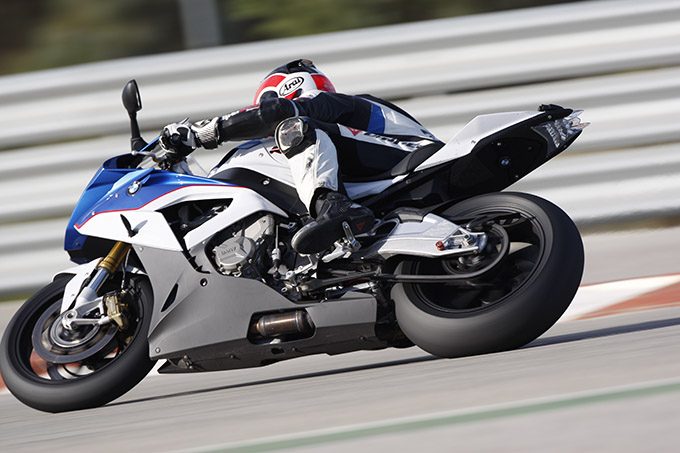
Highlights of the new BMW S 1000 RR:
- Increased power output and torque: 146kW (199hp) at 13,500rpm and 113Nm (83 lb-ft) at 10,500rpm.
- Even better rideability thanks to increased torque from approximately 5,000rpm upwards as well as a more linear curve. A broad plateau of peak torque available in the rev range from around 9,500 up to 12,000rpm.
- Re-engineered cylinder head with new duct geometry, new intake camshaft and even lighter intake valves.
- New intake system with shorter intake lengths, larger airbox and full E?gas ride-by-wire.
- Reduction in weight of 4kg to 204kg with a full tank of fuel (making allowances for equipment).
- New exhaust system weighing around 3kg lighter without a front silencer.
- Riding modes ‘Rain’, ‘Sport’ and ‘Race’ as standard plus the option of the Pro riding mode with two additional modes, ‘Slick’ and ‘User’ (configurable), for optimum adaptation to riding conditions.
- Launch Control for flawless starts as part of the optional Pro riding mode feature.
- Pit-lane speed limiter for maintaining an exact speed in the pit lane as part of the optional Pro riding mode feature.
- New, lighter frame structure with an optimised blend of rigidity and flexibility for more traction, greater precision and clear feedback.
- Refined chassis geometry for even better handling, increased traction and unequivocal feedback at the limits of performance.
- Fully adjustable spring elements with optimised negative spring travel for more banking clearance and greater agility.
- Further improved version of electronic Dynamic Damping Control (DDC), familiar from the HP4, as an ex-works option.
- Race ABS with optimised set-up.
- DTC traction control with precision calibration in 7 +/- steps.
- HP Gear Shift Assist Pro for fast clutchless upshifting and downshifting as an ex-works option.
- New electrical system with a more powerful sensor box and lighter battery.
- Electronic speed control as an ex-works option.
- More sophisticated instrument cluster with extended array of functions and wide variety of information.
- Completely restyled bodywork for an even more dynamic design language.
- Innovative colour schemes with three individual characters:
Racing Red / Light White, Black Storm metallic and BMW Motorsport. - Extended range of optional extras and special accessories available ex-works.


